
The short version: Freedom Forever LLC filed Chapter 11 bankruptcy on April 15, 2026 in Delaware. They were one of the biggest U.S. residential solar installers. They put in about 2 gigawatts of solar across 35 states and Puerto Rico. They owe $500 million to $1 billion. Between 50,000 and 100,000 people are owed money. The company owes $114 million to Mosaic, a solar loan company. The California Contractors State License Board had already put Freedom Forever on probation in October 2024. If Freedom Forever is on your contract, your payments don't stop. Your workmanship warranty is gone. Your production guarantee is worth nothing. The only thing you can act on today is the contract itself. If your loan has hidden dealer fees, federal Truth in Lending Act rules may give you a legal path forward.
On April 15, 2026, one of the biggest residential solar installers in the country walked into a Delaware bankruptcy court and filed for Chapter 11.
Freedom Forever LLC. Temecula, California. Operating in more than 30 states and Puerto Rico. More than $500 million in debt.
If the name on your solar contract is Freedom Forever, the company that installed your panels and promised you 25 years of worry-free savings is now fighting for its own survival. And whatever your salesperson told you about the "bumper to bumper" warranty, the production guarantee, and the lifetime support? That conversation just got a lot more complicated.
Here's what actually happens next, what it means for your payments, and what you can do about it.
What the filing actually says
Freedom Forever filed Chapter 11 on April 15, 2026 in the U.S. Bankruptcy Court for the District of Delaware. The filing lists:
$500 million to $1 billion in total liabilities
$100 million to $500 million in assets
$114 million owed to Mosaic, the residential solar loan financing company
A notice that "no funds will be available for distribution to unsecured creditors" after administrative expenses are paid
That last line is the one that matters most for homeowners. Unsecured creditors is a legal term that includes customers holding warranty claims, homeowners with pending repairs, and anyone who paid a deposit and is still waiting for service. If you're in that group, the filing is telling you in plain court language that there is nothing left for you.
Who Freedom Forever is (and why this is a big one)
Freedom Forever isn't a small regional installer. It's one of the largest residential solar companies in the country, reportedly operating in 30+ states plus Puerto Rico. The company was founded and led by Brett Bouchy, a former stockbroker who built Freedom Forever into a national installation footprint over the last decade.
If you live in California, Arizona, Colorado, Illinois, Texas, Utah, Nevada, Florida, or any of the other states where Freedom Forever operated, there is a real chance your panels or your neighbor's panels were installed by this company or one of its subcontractors.
This is not the first solar giant to fall, and it will not be the last. SunPower filed Chapter 11 in August 2024. Sunnova filed in June 2025. Pink Energy collapsed before them. SolarInsure has tracked more than 100 solar company bankruptcies and closures over the last three years. Freedom Forever is the latest name on that list, and it's one of the biggest.
The California warning that came 18 months ago
Here's the part most news coverage is leaving out.
In October 2024, the California Contractors State License Board (CSLB) placed Freedom Forever on probation after a long investigation into consumer complaints. California is the most regulated solar market in the country, and the CSLB doesn't put a company on probation over a handful of bad reviews. They do it after they've seen a pattern.
In the months that followed, homeowner complaints to the Better Business Bureau, state attorneys general, and consumer protection law firms continued to stack up. Specific complaints on public record include:
Installation quality issues and design flaws (inadequate snow guards, roof penetration problems)
Structural damage to homes during installation
Unresponsive customer service after problems were reported
Allegations of misleading sales tactics and contract misrepresentation
Multiple lawsuits alleging violations of the Telephone Consumer Protection Act (TCPA) tied to sales calls
The CSLB probation was a signal. The bankruptcy filing is the confirmation.
What happens to your contract, your loan, and your payments
This is the part that catches most homeowners off guard. When your solar company goes bankrupt, your contract does not disappear. Here is how each piece actually works.
Your monthly payments don't stop. If you financed your system with a Mosaic loan, a GoodLeap loan, Sunlight Financial, or any other third-party lender, that loan is separate from Freedom Forever. The lender bought your loan from the installer the day you signed. They are now the ones you owe, and they do not care that the company who put the panels on your roof filed bankruptcy. Your payment is still due on the first of the month.
Your lease or PPA transfers. If you have a solar lease or Power Purchase Agreement, the contract becomes an asset of the bankrupt company. The bankruptcy court will sell that contract, along with thousands of others, to whoever bids the highest. You will get a letter at some point telling you the new company name and the new payment address. Your terms don't change. The escalator clause buried in your contract is still there. The 25-year term is still there.
Your workmanship warranty likely just died. Most solar installations come with two separate warranties. The manufacturer's warranty (on the panels themselves, usually 25 years) is held by the panel maker (LG, Q Cells, Silfab, etc.) and survives the installer going bankrupt. The workmanship warranty (on the installation itself - the racking, the wiring, the roof penetrations, the labor) was held by Freedom Forever. It is now part of the bankruptcy. In practical terms, if your roof leaks next spring because of how they flashed around your panels, there is no one on the hook to fix it.
Your production guarantee is gone. If your salesperson promised your system would produce a specific amount of energy per year and Freedom Forever would make up the difference? That guarantee was worth only as much as the company standing behind it. It is now worth nothing.
Service calls, monitoring, and maintenance are gone or being transferred. The company that installed your system is no longer answering the phone. Whoever eventually buys the service contracts in bankruptcy may or may not be a real operating business. Many post-bankruptcy servicers are acquisition vehicles with skeleton crews - not installation companies with trucks and certified electricians.
What you can do right now
You don't have to wait for the bankruptcy to play out over the next 12 to 18 months before you understand where you stand. Here is what you can do today.
1. Pull out your contract and read it. All of it. Find the page that names the installer (Freedom Forever LLC), the page that names the financing company (Mosaic or other), the escalator clause if you have a lease or PPA, the workmanship warranty language, and the production guarantee language. These are the four pieces that just changed in value.
2. Keep paying your loan. For now. Stopping payments because the installer went bankrupt is one of the fastest ways to wreck your credit. The lender is a separate company. They will report missed payments to the bureaus no matter what happened to Freedom Forever. There may be legal grounds to dispute the loan itself (more on that below) but that is a separate process from simply not paying.
3. Document everything. Photos of any installation issues. Copies of any production reports from your monitoring app. Every text, email, and voicemail you sent to Freedom Forever customer service that went unanswered. This documentation is what your attorney or a consumer advocate is going to need if your case has a path forward.
4. File a complaint with your state attorney general. Every state AG office takes complaints against solar installers, and the complaints build a public record that regulators use to decide whether to pursue enforcement action. California homeowners should file with the CSLB and the California AG. Homeowners in other states should search "[your state] attorney general consumer complaint" and file directly.
5. Check whether your loan has legal violations. This is the part most homeowners don't know about. If you financed your solar system with a loan, there is a good chance a hidden dealer fee was added to your balance - sometimes adding thousands of dollars to what you owe - without being clearly disclosed. Under the federal Truth in Lending Act (TILA), every finance charge must be disclosed to you in writing. If the dealer fee wasn't disclosed, that is a TILA violation. And a TILA violation is a legal basis to challenge the loan itself - not just the installation.
That last one is why a lot of Freedom Forever customers still have options, even though the company filed bankruptcy. The installer going under doesn't erase the loan. But if the loan was written in a way that violated federal law, the loan itself can be challenged.
Why this keeps happening
Freedom Forever is not an outlier. It's a pattern.
Residential solar companies grow fast by selling aggressively door to door and over the phone, financing the customer with a third-party lender, pocketing a dealer fee up front, and then leaving the installation, the warranty, and the 25-year service obligation on a balance sheet they can't support. When financing costs rise, when state net metering rules change (California's NEM 3.0 cut rooftop solar economics by 80%), or when subsidies shift, the whole model snaps.
The homeowner is left with a 25-year loan or lease and a company that no longer exists.
This is the pattern regulators, consumer protection attorneys, and state AG offices are finally catching up to. It's also why the list of "former" solar giants keeps growing: SunPower, Sunnova, ADT Solar, Pink Energy, and now Freedom Forever.
The question most Freedom Forever customers are about to ask
If you signed a contract with Freedom Forever and you're sitting with that contract in your hand right now, the question is the same one every customer of a bankrupt solar company eventually asks: Am I stuck, or do I have options?
The honest answer is: it depends on what's actually in your contract, what your salesperson did or didn't disclose, and whether your loan was written in a way that complies with federal law. Most Freedom Forever customers don't know the answer because no one has ever walked through the contract with them in plain English.
That's what the free Solar Relief Assessment is for. A senior consultant reviews your contract with you on the phone, in plain language, and tells you what relief you and your family may qualify for. No charge. No obligation. No high-pressure pitch.
Freedom Forever isn't calling you back. Someone should.
Sources (for fact-check pass before publishing)
Bloomberg: "Freedom Forever Files Bankruptcy as Solar Industry Woes Deepen" (2026-04-15)
Law360: "Solar Co. Freedom Forever Hits Ch. 11 With Over $500M Debt"
PV Magazine USA: "Residential solar company Freedom Forever files chapter 11 bankruptcy" (2026-04-15)
Solar Power World: "Residential solar installer Freedom Forever files bankruptcy"
BKData filing record: Freedom Forever LLC case #26-10522, D. Del., filed 2026-04-15
BBB complaints: Freedom Forever LLC, Temecula CA profile
FairShake: "Your Freedom Forever Lawsuit Questions Answered"
California CSLB license record: probation order October 2024
SolarInsure: "The Complete List of Solar Bankruptcies and Business Closures"
Hero Image Brief (brand-focused, NOT Sal)
Concept direction (pick one, generate, review with Damian before locking):
Option A — "The Closed Sign" (strongest editorial pick).
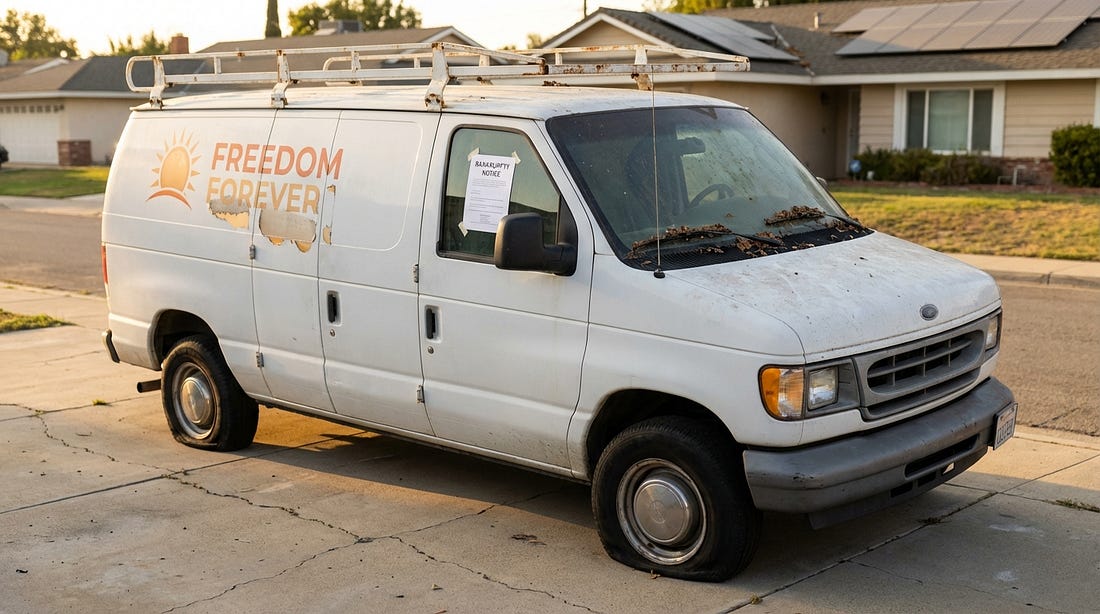
A Freedom Forever branded work van (orange and white, ladder rack, company logo visible on the side panel) parked in a residential driveway. Dusty, clearly not in service. A "RETURN TO SENDER" or "OUT OF BUSINESS" style notice taped on the windshield. Shot at golden hour, long shadows, quiet street. Editorial photojournalism style. Conveys: the company that showed up at your door is gone. No people in frame.
Option B — "The Filing."
Close-up overhead shot of a stack of bankruptcy court documents on a desk, with "FREEDOM FOREVER LLC" visible on the top page header and "CHAPTER 11 VOLUNTARY PETITION" readable. A Freedom Forever branded pen or folder beside the stack. Document style, newsroom neutral. Conveys: this is real, on the record, in federal court.
Option C — "The Empty Roof."
Wide shot of a suburban house from the street. Solar panels on the roof, clearly installed. A small Freedom Forever yard sign in the front lawn, slightly faded. House looks lived-in but nobody home. Overcast sky. Conveys: the panels are still there. The company isn't.
Recommendation: Option A. Strongest visual storytelling, most shareable on social, matches the news-peg tone of the article, and puts the Freedom Forever brand center-frame without crossing into ridicule.
Technical specs:
1456x816 or 1200x675 (Substack hero ratio)
Tool: Gemini for photorealistic scene (not Sal generator)
Negative prompt: no people, no mascots, no eagles, no cartoon elements, no text overlays
Brand color accent: orange (Freedom Forever's actual brand) visible but not dominant
Mood: editorial, quiet, consequence-heavy — not inflammatory or mocking
Freedom Forever Filed for Bankruptcy. You Still Have Options. Find Out What They Are.
If the name on your solar contract is Freedom Forever, your warranty, your production guarantee, and your service calls just changed in value. But your loan didn't disappear, and depending on how it was written, you may have legal grounds to challenge it. A free Solar Relief Assessment walks you through what's actually in your contract and what relief you and your family may qualify for.
[Get free Solar Relief Assessment →](https://solarhomeadvocate.com/free-assessment?utm_source=substack&utm_medium=article&utm_campaign=industry-news&utm_content=freedom-forever-bankruptcy)Get free Solar Relief Assessment →**
No charge. No obligation. No high-pressure pitch.
---
"Sal says: When your solar company goes bankrupt, your loan doesn't disappear, your lease doesn't cancel, and your payments don't stop. The only thing that disappears is the company on the hook to fix things when they go wrong."
---
Frequently Asked Questions
Did Freedom Forever file for bankruptcy?
Yes. Freedom Forever LLC, the Temecula, California-based residential solar installer, filed for Chapter 11 bankruptcy protection on April 15, 2026 in the U.S. Bankruptcy Court for the District of Delaware. The filing listed $500 million to $1 billion in debt and $100 million to $500 million in assets, including $114 million owed to the solar loan financing company Mosaic. The filing also indicated that no funds would be available for distribution to unsecured creditors after administrative expenses.
What happens to my Freedom Forever solar panels now that the company filed for bankruptcy?
Your panels are yours (if you bought them) or remain leased (if you have a lease or PPA). They will keep producing electricity. What changes is the service, warranty, and guarantee behind them. The manufacturer's panel warranty (typically 25 years, held by the panel maker) survives. The workmanship warranty and production guarantee held by Freedom Forever are now part of the bankruptcy and likely unrecoverable. Your monthly loan or lease payment continues regardless because the financing company is separate from the installer.
Do I still have to pay my solar loan if Freedom Forever went bankrupt?
In almost all cases, yes. Your loan is held by a third-party lender (Mosaic, GoodLeap, Sunlight Financial, or similar), not by Freedom Forever. The lender is a separate company and will continue to bill you and report missed payments to the credit bureaus. Stopping payments will damage your credit. However, if your loan was written in a way that violated the federal Truth in Lending Act (for example, an undisclosed dealer fee), the loan itself may be legally challengeable - which is a separate process from simply not paying.
What was Freedom Forever in trouble for before the bankruptcy?
In October 2024, the California Contractors State License Board (CSLB) placed Freedom Forever on probation following an investigation into consumer complaints. The company has also faced lawsuits alleging violations of the Telephone Consumer Protection Act (TCPA), numerous Better Business Bureau complaints citing installation quality issues and unresponsive customer service, and allegations of misleading sales practices.
How many states did Freedom Forever operate in?
Freedom Forever operated in more than 30 states and Puerto Rico at the time of the bankruptcy filing, including California, Arizona, Colorado, Illinois, Texas, Utah, Nevada, and Florida, among others. The full active-market list per Freedom Forever's own site at the time of filing included Arizona, California, Colorado, Connecticut, Delaware, Florida, Georgia, Illinois, Maine, Maryland, Massachusetts, Michigan, Missouri, Nevada, New Hampshire, New Jersey, New Mexico, Ohio, Oregon, Pennsylvania, Puerto Rico, Rhode Island, Texas, Vermont, Virginia, Washington, Wisconsin, plus D.C.
What should I do if Freedom Forever installed my solar system?
First: keep paying your loan. The lender (Mosaic, GoodLeap, Sunlight Financial) is a separate company from Freedom Forever. Missed payments will hurt your credit. Second: pull out your contract. Read the installer name, the loan company name, the escalator clause, the warranty language, and the production guarantee language. Third: document every problem. Take photos of install issues. Save unanswered service calls. Fourth: file a complaint with your state's Attorney General. Every state has a consumer protection office with an online form. Fifth: look at your loan paperwork for a dealer fee. If the fee wasn't shown to you in writing, that can be a federal Truth in Lending Act violation. That's a legal basis to challenge the loan.
Can I sue Freedom Forever after the Chapter 11 filing?
No, not directly. The bankruptcy filing triggers an automatic stay. That blocks civil lawsuits against the company. Your real path forward is two steps. First: file a claim in the bankruptcy case if you're a creditor. Second: look at your loan. The lender is a separate company. The bankruptcy stay does NOT protect the lender. If your loan has a Truth in Lending Act violation, the loan itself can often be challenged or renegotiated.