
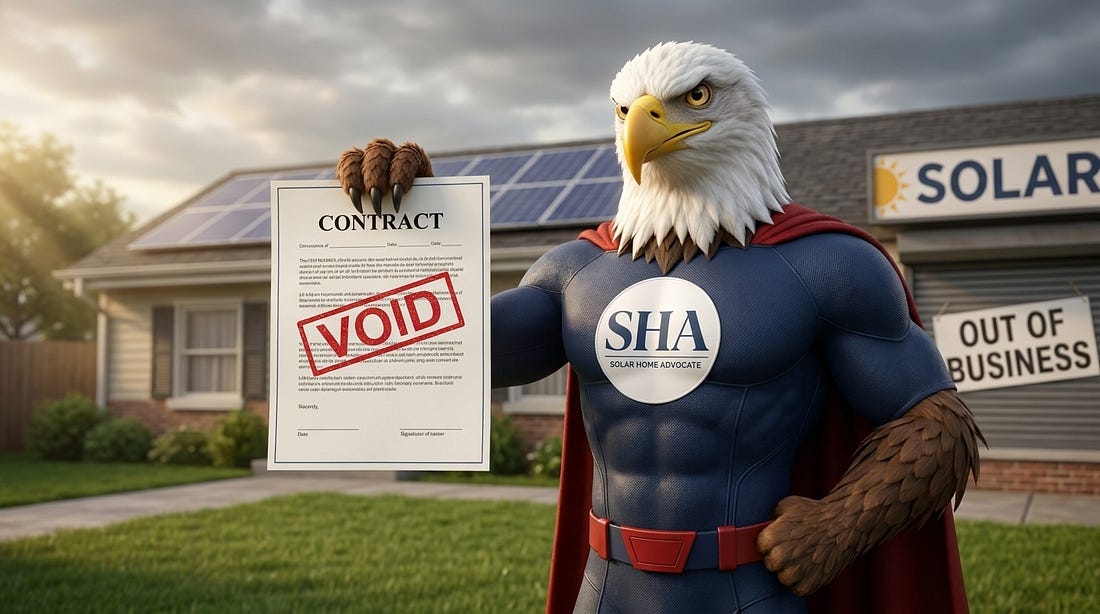
The short version: Two states just went to court to cancel thousands of solar loans and hold the lenders responsible, not only the solar companies. The tactics behind those loans, "free" or government solar, a rushed signature, costs nobody explained, show up all over the country. If you have solar, it's worth finding out what's really in your agreement. Our free 30-second assessment is the easy way to start.
You were told solar would basically pay for itself. Maybe you were even told the government was footing the bill. So you signed.
Now the bill shows up every month, the savings never quite showed up with it, and you're left wondering what you actually agreed to that day.
Here's something most homeowners don't know. That same promise, free solar, government solar, nothing out of pocket, is now at the center of lawsuits in more than one state. And the people who signed are being told they may not owe what they thought.
In March, the New York Attorney General sued a solar company called Attyx, along with two lenders that financed its deals, Solar Mosaic and WebBank. The state says the company pulled in about 275 million dollars in New York by promising "free" solar and government programs that turned out to be neither, then rushing people, many of them seniors on fixed incomes, through paperwork they never got to read.
The part that matters for you is what the Attorney General asked the court to do. Not just a fine. She asked the court to cancel every one of those loan agreements.
Sal says: In New York, the state didn't just fine the solar company. It asked a judge to erase the loans entirely. Because when the sale is built on a promise that wasn't true, the paper stacked on top of it can come apart too.
Then in July, Michigan did something similar with a different company. Its Attorney General sued Climax Solar and the banks that financed its customers. Climax had already filed for bankruptcy and closed its doors back in 2024. But the loans didn't close with it. About 1,700 Michigan families are still making payments on solar that the company walked away from.
So the state went after the money. Not just the installer that's already gone, but the lenders still collecting every month.
Sal says: Climax Solar shut down in 2024. The loans didn't. About 1,700 families are still paying, which is exactly why the state is now going after the banks, not only the company that disappeared.
Now, maybe you've never heard of Attyx or Climax. That's fine. Because this was never really about two companies.
Notice what keeps showing up in these cases. Solar sold as "free" or government-backed. A signature collected fast, before anyone reads the fine print. A loan the homeowner never fully saw. That's not one bad apple. That's a playbook, and it's been used all over the country.
And this isn't only for people who feel cheated. Plenty of folks signed with a company that's perfectly fine, and the agreement still hides a surprise. An escalator that raises the payment every year. A lien sitting on the house. A warranty that quietly died the day the installer went under. You can't fix what you can't see.
So the real question isn't whether it was Attyx, or Climax, or the company that knocked on your door. The question is simpler, and it's about you. What's actually in the agreement you signed, and does it hold up?
You're probably thinking: okay, how would I even know? I'm not a lawyer, and I don't know what half of that contract says.
You don't have to. That's the whole point of what we do.
Take our free 30-second Solar Relief Assessment. You answer a few quick questions about your solar, when you signed, how you were sold, whether anything feels off, and a senior advocate calls you back within a day, at no cost, to go through what's really in your agreement and what your options are. Nothing is sold on that call.
Do it today. Because the time to find out whether your agreement holds up is before your bill jumps again, or before the company behind it disappears like the others did.
Sal says: You don't need to prove anything to get started. You just need to know what you signed. A free review tells you that in plain English, and it costs you nothing to find out.