
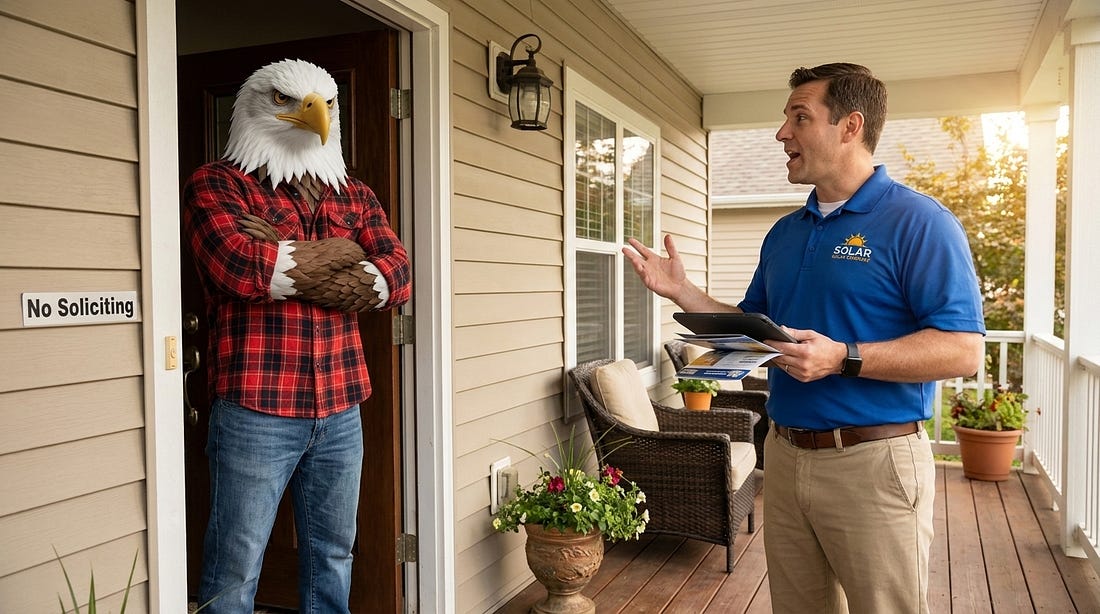
The short version: "Free solar" doesn't mean free. It means a solar company owns the panels on your roof, you pay them every month for 20 to 25 years, and they keep all the tax credits. That's not free. That's a long-term deal. There's really only one question that matters for any solar contract: do you own the panels, or does the solar company? Everything else flows from that. If you took out a loan, you own them. If you signed a lease or PPA, you don't. This article explains why it matters and how to find out which one you have.
If someone came to your door and told you they could put solar panels on your roof for free — they weren't exactly lying. But they also weren't telling you the whole truth either.
"Free" doesn't mean you own the panels. It means someone else owns them. That someone else puts the panels on your roof. And you pay them every month for the next 20 to 25 years.
That's not free. That's a long-term deal with a company that owns equipment attached to your home.
---
The one question that matters
Here's the simplest way to understand your solar situation.
Do you own the panels on your roof — or does a solar company?
That's it. Everything else flows from the answer.
---
If the solar company owns your panels
You signed a lease. Or you signed a PPA (power purchase agreement). The difference doesn't really matter. Either way, here's what you agreed to:
The solar company owns the equipment on your roof.
You pay them every month for the electricity it produces.
They keep the tax credits and incentives. Not you.
Your monthly payment probably goes up every year. That's the escalator clause.
You can't just remove the panels if you want out. There are penalties.
If you try to sell your home, the buyer has to agree to take over your deal. Many won't. And if they don't, you may have to pay off the full remaining contract — often $7,000 to $30,000 or more — just to close.
Most homeowners who were told "solar is free" signed one of these. The salesperson's job was to explain the difference. In most cases, they didn't.
---
If you took out a solar loan
You own the panels. But you're paying for them through a 20 to 25 year loan. And this is where a lot of homeowners run into problems they never expected.
Yes, you own the equipment. Yes, you keep the tax credits. But here's what most homeowners with solar loans are dealing with:
You're paying a monthly solar loan payment AND still paying a utility bill. The "savings" your salesperson promised? For many homeowners, they never showed up.
Many solar loans have hidden dealer fees. Typically 15 to 30 percent of the loan balance. They get rolled into the principal. They don't get listed as a separate charge. That's a potential Truth in Lending Act violation.
The total cost of the loan over 20 to 25 years is often far more than what you were told the system would cost at the sale.
If the system doesn't produce what was promised, you're still on the hook for the full loan.
Owning the panels doesn't mean the deal was fair. Many solar loans have legal violations in how the loan was structured, how fees were disclosed, or how the total cost was presented. If violations are there, you may have options you don't know about — including debt relief, contract challenges, or loan renegotiation.
---
How to find out which deal you signed
Pull out your contract. Look at the first page or two. It will say one of these near the top:
"Solar Lease Agreement" = the company owns the panels.
"Power Purchase Agreement" (PPA) = the company owns the panels.
"Loan Agreement" = you own the panels.
Can't find your contract? Can't make sense of the language? That's normal. That's what a free Solar Relief Assessment is for. Someone walks you through it.
---
Why "free solar" became a sales pitch
"Free" is a powerful word. It gets people to open the door. It gets people to listen. It gets people to sign.
The solar industry learned this. Walk through almost any neighborhood in the country where door-to-door solar sales teams operate and you'll hear variations of the same pitch:
"There's a government program that covers the cost."
"Your utility is paying for it."
"You qualify for free solar if you sign today."
"It replaces your electric bill — no out-of-pocket cost."
None of these are true the way they're usually sold.
There's no government program that makes solar free for homeowners. Your utility isn't paying for your system. The "qualifying" language is a sales funnel, not a financial test. And the "replaces your electric bill" claim hinges on savings projections that often don't pan out.
The federal solar tax credit is real. It's currently 30% of the system cost. But it only matters if you have enough federal tax liability to use it. Many seniors on fixed incomes don't. And if you signed a lease or PPA, the solar company keeps the credit anyway — not you.
---
Why this matters so much
The type of deal you signed changes everything:
Who's responsible when something breaks (you or the solar company)
Whether your payment goes up every year (often yes, with an escalator)
What happens when you want to sell your home (transfer, pay off, or stuck)
Whether you can get out of the deal at all (and what it costs)
How much the whole thing actually costs over 20 to 25 years (often far more than the quote)
This becomes even more critical with the wave of solar companies and installers going bankrupt and out of business.
A lot of homeowners are paying for a deal they didn't fully understand when they signed it. That's not their fault. Solar contracts are long, written in language most people aren't meant to fully understand, and delivered under high-pressure kitchen table conditions.
Understanding the deal now is the first step to knowing your options.
Not Sure What Kind of Solar Deal You Signed?
Most homeowners don't know if they signed a lease, a PPA, or a loan. And their salesperson didn't explain the difference. If you want someone to walk you through what you actually signed and what it means for you and your family, start here.
[Get free Solar Relief Assessment →](https://solarhomeadvocate.com/free-assessment?utm_source=substack&utm_medium=article&utm_campaign=launch&utm_content=free-solar-truth)Get free Solar Relief Assessment →**
No charge. No obligation. No high-pressure pitch.
---
"Sal says: If someone told you solar was 'free,' you probably signed a lease or a PPA. That means a company owns the panels on your roof. And you're paying them every month for the next 20 to 25 years. Most homeowners who signed those deals are not getting the savings they were told about."
---
Frequently Asked Questions
Is "free solar" actually free?
No. "Free solar" is a sales phrase, not a financial reality. It usually means a solar company owns the panels on your roof and you pay them every month for the electricity the system produces — typically for 20 to 25 years. That's a solar lease or a power purchase agreement (PPA). The panels aren't yours. The tax credits go to the company, not you. And your payments usually go up every year through an escalator clause.
What's the difference between a solar lease, a PPA, and a solar loan?
A solar lease and a PPA both mean the solar company owns the panels. You pay them every month — either a flat lease payment or a rate per kilowatt-hour produced. Neither gives you the panels, the tax credits, or full control over removal. A solar loan means you own the panels outright. You make loan payments to a separate lender. You keep the federal tax credit if you qualify. But solar loans often have hidden dealer fees of 15 to 30 percent rolled into the balance.
Does the federal solar tax credit cover my whole solar system?
No. The federal Investment Tax Credit (ITC) is 30% of the system cost (as of 2026), not 100%. And it only applies if you have enough federal tax liability to use it. Many seniors on fixed incomes, retirees, or homeowners with low taxable income can't fully use the credit. If you signed a lease or PPA, the solar company takes the credit, not you.
Does my utility pay for solar installations?
No. Your utility is not funding your rooftop solar. Some states and utilities offer rebates or net metering programs (which credit you for electricity your panels send back to the grid). But the utility is not paying for your system. Any salesperson who said otherwise was misleading you.
What if my solar salesperson said "the government pays for it"?
That claim is not accurate. There is no federal program that makes solar free for homeowners. The federal tax credit covers 30% of system cost, not all of it, and only for homeowners with enough tax liability. If your salesperson said "the government pays" or "the utility pays," that's a potential consumer fraud claim under your state's deceptive trade practices law. Document the pitch and consider filing a complaint with your state attorney general.
Can I get out of a solar lease or PPA?
It's hard, but not always impossible. Options include: (1) the 3-day FTC Cooling-Off Rule if the sale was at your home, (2) state-specific cancellation rights if proper disclosures were missing at signing, (3) consumer fraud claims if the sale involved misrepresentation, (4) the transfer-to-buyer path if you're selling your home, (5) a buyout (often $7,000 to $30,000 or more), or (6) contract cancellation if your state AG files enforcement that covers your installer. Every case is different — which is what a free contract review is for.
How do I find out if I have a solar lease, PPA, or loan?
Pull out your contract. Look at page one. It will say "Solar Lease Agreement," "Power Purchase Agreement," or "Loan Agreement" near the top. If you financed through a third-party lender like Mosaic, GoodLeap, Sunlight Financial, or Cross River Bank, it's a loan. If you pay the solar company directly for the electricity the system produces, it's a lease or PPA.