
By Solar Home Advocate
Yesterday we said 9 of the most recognized solar brands didn't make the grade. Today we're going to show you exactly why.
Here's the thing about a failed solar company. You don't see it coming. The salesman who came to your door looked clean cut. The contract had a 25-year warranty. The company had a website with smiling families on the homepage.
Then your bill goes up. The production app stops updating. The phone number stops working.
By the time you notice, the failure is already on public record. It's been there for years. You just didn't know where to look.
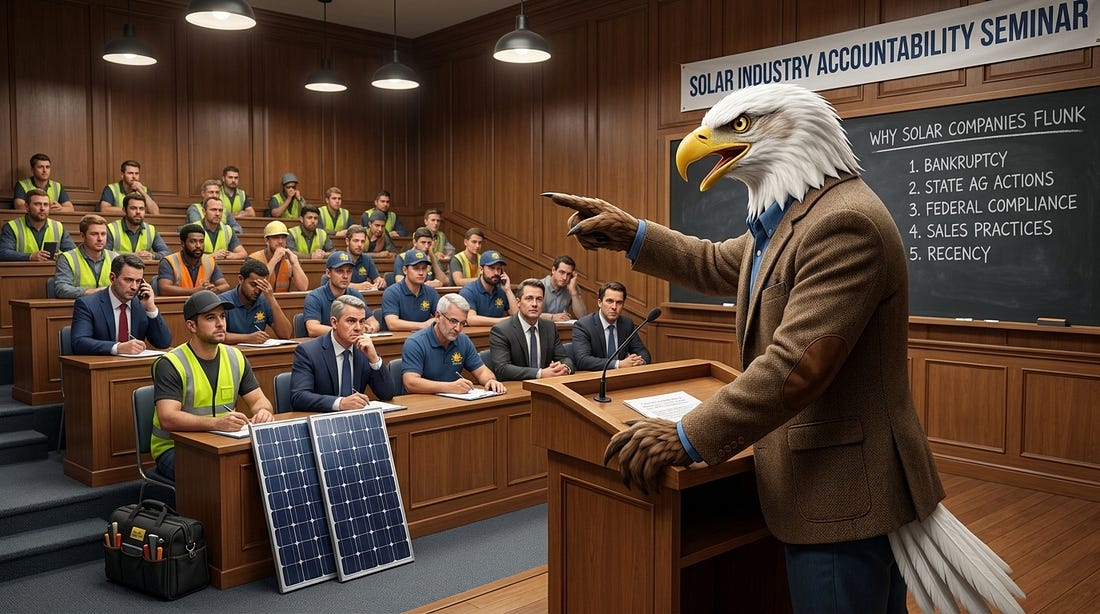
The Eagle's Eye looks in five places. Five small ways a solar company shows you it's coming undone before the lights go out for good.
Here's the first one.
Reason 1: They Went Bankrupt.
Picture it. It's year three of your solar contract. The roof springs a leak right where the panels are mounted. You pull out the warranty paperwork and dial the number.
The number rings out.
You try the website. The website now redirects to a different company's sales page. You call the finance company. They tell you the loan still has 22 years left to run.
That's bankruptcy from the homeowner's seat. The warranty you bought becomes a creditor claim in federal court. The loan you signed does not. The roof stays your problem.
Freedom Forever filed Chapter 11 on April 15, 2026 in Delaware. They owe between $500 million and $1 billion. Between 50,000 and 100,000 people are owed money. They operated in 26 states.
That earned them a D in The Eagle's Eye. Bankruptcy puts a structural cap on the grade. A bankrupt company can't go higher than a D. Because if you can't reach the company, the rest of the record doesn't matter.
Reason 2: A State Attorney General Already Sued Them.
Quick test. Pull your last solar bill. Read the company name at the top. Now go to your state attorney general's website and type that name into the search bar.
If something comes back, you have your answer. If nothing comes back, that's also an answer for now.
Sunrun is the largest residential solar installer in the country. The Connecticut Attorney General sued them in July 2024. The complaint listed forged signatures. Customer impersonation. Solar systems that didn't work.
The Texas Attorney General has an open investigation. Texas solar complaints went from 154 in 2020 to 696 in 2024. A 352 percent jump in four years.
That earned them a B-minus. Honestly, that's generous. The C tier was right there.
Sal Says: A press release in one state usually means complaints building in five. Pull your installer's name in your AG's database first. Then pull it in three neighboring states. Patterns travel.
State AG records are the most reliable signal of long-running consumer harm. Because what shows up in court today was happening at homeowners' kitchen tables three years ago.
Reason 3: A Federal Agency Has Their File Open.
Quick question. Who is your finance company?
Most homeowners can't name them. They paid the salesman. The salesman handled the paperwork. The bill goes to a company you'd recognize. The loan goes to a company you wouldn't.
That's the gap. And that's where the federal agencies live.
The Consumer Financial Protection Bureau watches the lending side of solar. Hidden dealer fees. Truth in Lending violations. The Federal Trade Commission watches the sales side. False savings claims. Inflated tax credit promises.
Solar Mosaic is one of the biggest solar lenders in the country. The New York Attorney General named them in a March 2026 lawsuit. The complaint alleges $275 million in solar fraud across the state. Their lending partner, Attyx LLC, is named alongside them. A federal class action followed.
That earned Solar Mosaic a C-plus.
The dealer fee is what makes the math stop working. It's the silent 20 to 30 percent markup buried in your loan that nobody mentioned at the kitchen table. You're paying it every month. Most homeowners don't know it exists.
Reason 4: Their Sales Tactics Are On the Public Record.
Remember the salesman.
Maybe he came to your door. Maybe he caught you at a Costco kiosk. Maybe he showed up at a senior community event. Whoever he was, he had a tablet. He had a quote. And he had a deadline.
If you signed that day, the rebate would expire. The price would go up. The panels would pay for themselves in seven years. The company was working with your utility to lock in pricing.
Some of those statements were true. Many were not. The false ones are the same false ones state attorneys general are now suing solar companies over.
Vision Solar got sued by the Florida Attorney General for high-pressure sales and misrepresented savings. Sued by the Connecticut Attorney General. Ordered to pay $5 million in October 2024. Sued by the Arizona Attorney General. Inflated savings claims. Illegal telemarketing.
Then New Jersey. Massachusetts. Pennsylvania. A handful of other states. More than 60 pending legal actions before the company filed for Chapter 11.
That earned them an F.
Sal Says: If your salesman pressured you to sign that day. If they said the rebate would expire. If they told you the panels would pay for themselves. Those are the exact phrases AGs are suing solar companies over right now. Your contract is the receipt.
Reason 5: The Trouble Is Recent. Or It Is Right Now.
Mark your calendar. On March 17, 2026, the New York Attorney General filed a lawsuit against Attyx LLC, formerly known as SUNco. The complaint alleges $275 million in solar fraud. The targets named in the complaint were low-income New Yorkers and seniors on fixed incomes.
The case is six weeks old. Attyx is still operating. They're still on doorsteps somewhere this week.
Six weeks. That's all it takes for a solar company to go from clean record on paper to facing a $275 million state lawsuit.
Here's the part that matters most for you. The 60 days after a major AG filing is when homeowners have the strongest legal options. It's when documents are still findable. When timelines are still provable. When statutes haven't run out.
Wait two years and many of those options are gone.
What All Five Reasons Have in Common.
They are all on the public record. None require a private investigator. None require a lawyer. They just require knowing where to look.
That's what The Eagle's Eye does. It looks in all five places at once. It gives you the result in five seconds. Court records. Bankruptcy filings. Federal complaints. State AG press releases. Dates.
Pull your company's name. See what shows up. That's the whole game.
Pull Your Grade Today.
How do you know if your installer is the next one to flunk?
You don't. You pull the grade.
You read the five category scores. You see what the public record shows. A B-plus with no concerning items in any category is a different story than a B-minus with two AG actions and an open Texas investigation. The grade tells you which one you're holding.
It takes five seconds. It costs nothing. It tells you what kind of company is on the other end of your contract. And what kind of leverage you still have.
Pull it today. Because the cheapest time to find out something is wrong is before the next bankruptcy filing. Before the next attorney general press release. Before the next homeowner like you wonders why their bill went up and the company stopped picking up.
**→ Look up your solar company at SolarHomeAdvocate.com/eagle-eye**
This is piece #2 of Week 1 on The Eagle's Eye. Tomorrow we look at the other side of the wall. We'll show you what an A-graded solar company actually looks like, and why those report cards still earn a free second opinion on your contract.