
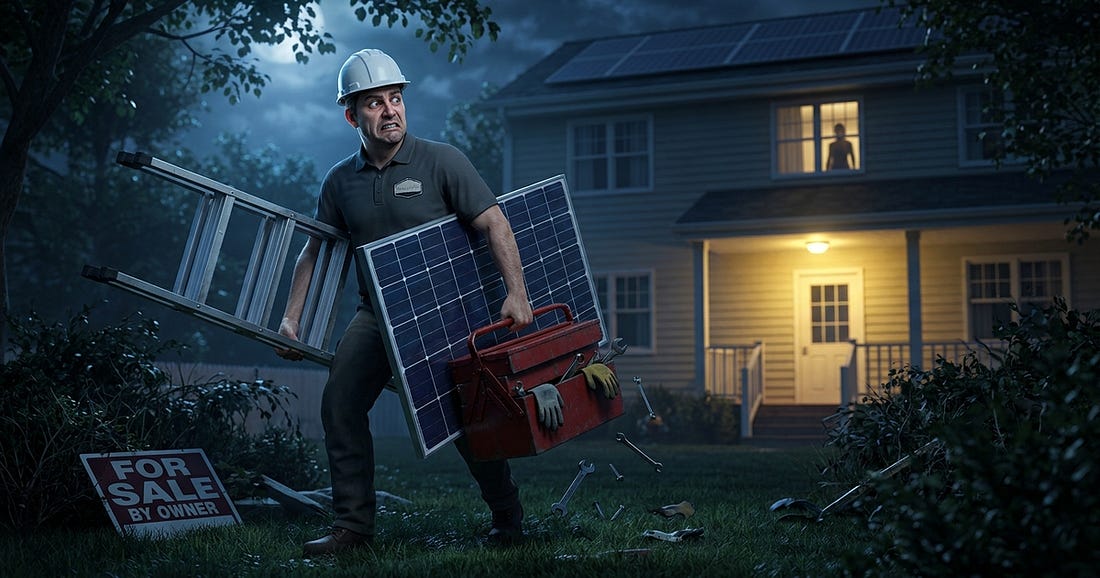
You've called the number on the paperwork. It rings and rings. The email bounces. The website is "under maintenance." The salesman who talked you through it on your porch that night? He's nowhere to be found.
Your installer stopped answering your calls. But they're still sending you their bill!
Your panels are still there. Your payment is still coming out of your account every month.
If that's you, you're not imagining it. And you're not alone.
Roughly half a million American homeowners are making payments right now to solar companies that have either gone bankrupt, been quietly shut down, or slipped out the back door and handed your contract to somebody you've never heard of.
It's happening every week. And most homeowners have no idea what it actually means for them.
The Solar Vanishing Act
Let's call it what it is. There's a pattern going on across the solar industry, and it has four flavors:
1. The big bankruptcy. Freedom Forever, the top residential solar installer in the country last year, filed Chapter 11 in Delaware on April 15, 2026. Their liabilities are somewhere between $500 million and $1 billion. Before that, Sunnova filed in June 2025 with $10.67 billion in debt and roughly 500,000 customers. Before that, Titan Solar Power in Arizona. Before that, SunPower. Before that, Pink Energy. The list keeps growing.
2. The quiet close. The smaller installers don't file bankruptcy. They just shut the lights off. The phone stops working. The website goes dark. You find out when you need service and nobody's there.
3. The handoff. Your contract gets sold. You find out when a bill arrives from a company you've never heard of. Sunnova's contracts are being handed to a servicer called SunStrong. Solar Mosaic's $15 billion loan book went to Solar Servicing LLC, a Forbright Bank subsidiary. Same payment. Same terms. Different name. And good luck getting warranty work out of them.
4. The slow ghost. The company still technically exists. But the warranty calls don't get returned. The production data stops showing up. The service tech who was supposed to come never does. They haven't closed. They've just stopped pretending to do the job they signed up for.
Whichever flavor you're living with, the outcome feels the same from your kitchen table. Your installer is gone. Your contract is not.
Sal says: Over 500,000 American homeowners are paying right now for solar systems from companies that have vanished or been handed off. If that sounds like you, keep reading.
Why the Contract Didn't Leave With Him
Here's the part that catches most homeowners off guard. Your solar contract is not the installer. It's a separate piece of paper with a separate life.
If you signed a solar loan, your loan got bundled with thousands of other loans and sold to a financial company long before the installer hit trouble. You still owe that money, and a loan servicer you never chose is collecting it.
If you signed a solar lease or PPA, the lease was an asset the company owned. When the company went under, somebody bought that asset. You're still locked in - same monthly payment, same escalator clause, same 20 or 25 year commitment. Just a new name on the bill.
If you paid cash, you own the panels outright. The bankruptcy does not take them from you. But it likely takes your warranty.
So your contract lives on. Your obligations stay. Your support disappears.
The Warranty Probably Died First
This is the part that stings.
That 25-year production guarantee? The 10-year workmanship warranty? The promise that somebody would show up if something went wrong? Those warranties are contracts with a company that no longer exists. Or no longer cares.
The new servicer that bought your contract has no legal duty to honor the old warranty unless they specifically agreed to. And most didn't.
In Connecticut alone, the Attorney General has opened investigations after more than 65 complaints against SunStrong, the servicer now handling contracts that used to belong to bankrupt solar companies. Warranty refusals. Billing problems. Some homeowners were even being charged $10 a month just to see their own solar production data.
Sal says: The warranty likely died with the company. The servicer that bought your contract does not have to honor it. That's worth finding out before your next panel problem.
The Part Nobody Tells You: You May Have Legal Options
Here's where it gets interesting.
If the company that sold you the system made misrepresentations, those violations do not disappear when the company does. Promised savings that never came. Fees hidden in the loan. A lease pitched as a "government program." A signature pushed through on a tablet you barely had time to read. Those claims stay on the contract. And they have legal weight.
Start with the fees. The average solar loan in 2026 carries a dealer fee of roughly 22% of the system price, about $5,700 on a typical install. Most homeowners were never told about it. That alone can be a Truth in Lending Act problem.
Then the savings claims. If you were told your electricity bill would "disappear" and you're now paying a solar payment AND a utility bill, that broken promise has weight - especially when state attorneys general are investigating the same companies for the same pitches.
Right now, attorneys general in New York, Texas, Connecticut, Arizona, and Virginia all have active solar enforcement underway:
New York: $275 million lawsuit against Attyx (formerly SUNco) and two of its lenders for fake "government program" pitches aimed at seniors
Texas: April 2026 investigation into Freedom Forever, SunRun, Lone Star Solar Services, and CAM Solar, with more than 100 formal complaints on file
Connecticut: active investigations against six different solar companies, including the servicer SunStrong
Arizona: $13.8 million penalty against Vision Solar and Solar Xchange for telemarketing and savings fraud
Virginia: lawsuit against Pink Energy founders covering more than 4,000 households
FTC solar complaints are up 746% since 2018. Regulators are paying attention now in a way they were not three years ago.
Sal says: If the company that sold you solar broke a consumer protection law, that claim did not go away when they did. Your contract is still in play. So are your options.
What To Do This Week
If your installer has gone quiet, been sold, or filed for bankruptcy, here's where to start:
1. Find out who owns your contract now. Look at your most recent bill. The company name may have changed. If no bill has come and you still owe, that's a red flag worth flagging.
2. Pull out your original contract. Look for an escalator clause, a dealer fee line, auto-renewal terms, and anything the salesperson promised out loud that never made it onto the page.
3. Check whether your state attorney general is investigating. If your installer or lender is named in an active case, your situation may be stronger than you think.
4. Take the free Solar Relief Assessment. A senior solar relief consultant can read what you signed, tell you in plain English what you actually agreed to, and walk you through whatever real options you have. Cancellation. Loan forgiveness. Something else entirely.
The first step is easy. It's free, and it takes less than thirty minutes.
**Take your free Solar Relief Assessment →**
No charge. No obligation. No high-pressure pitch. Just a straight read of what you signed, from people who look at these contracts every day.